
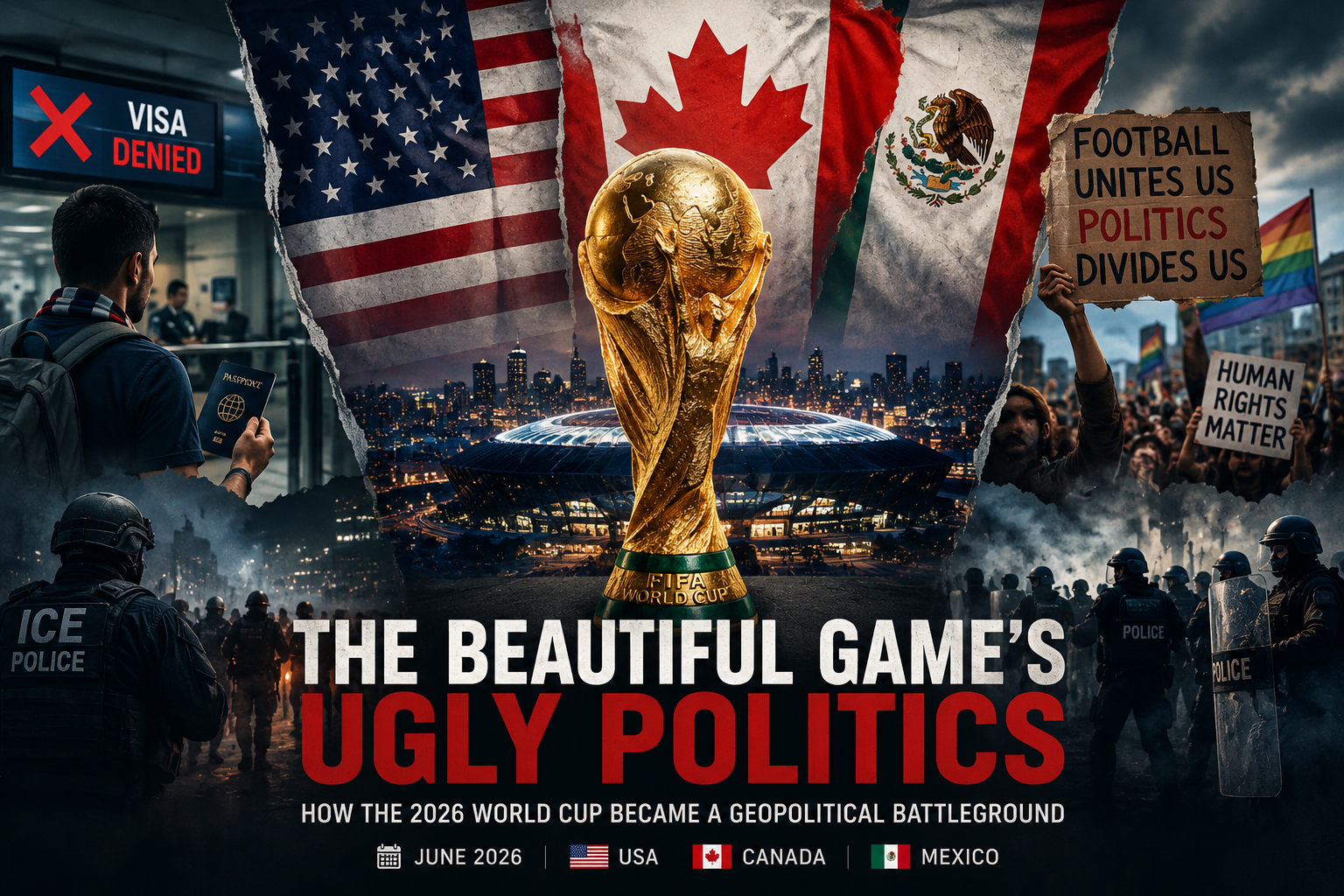
When a sporting tournament becomes a flashpoint for visa wars, human rights abuses, and security fears—and why it matters for the future of international sports
June 2026 | Analysis of controversies reshaping the world’s largest sporting event
In five weeks, 16 cities across three nations will host the largest sporting tournament in human history. The 2026 FIFA World Cup will welcome nearly 80 matches, 48 national teams, and an expected 5 million fans across North America. Yet beneath the excitement of football, a more troubling narrative has emerged one where politics doesn’t simply intersect with sport, but threatens to fundamentally reshape how the world’s largest teams can participate in and attend the game.
This is not the story of match tactics or player transfers. This is the story of how a sporting tournament has become a battleground for geopolitical tensions, visa wars, immigration enforcement, human rights concerns, and the tension between security and freedom. And it matters far more than any goalkeeper’s distribution pattern.
The Visa Crisis: When Politics Blocks the Turnstiles
Picture this: You’ve waited years for your country to qualify for the World Cup. You’ve saved money. You’ve bought a ticket. You’re ready to travel thousands of miles to see the tournament of a lifetime. Then the United States government tells you that you’re not welcome—not because you’ve committed a crime, but because of where you were born.
This scenario is no longer hypothetical for millions of football fans. President Donald Trump issued a proclamation restricting or limiting the entry of nationals from 19 countries on June 4, 2025, and expanded the list to 39 nations on December 16, 2025. Fans from each of these countries will largely be unable to attend any games in the U.S. during the tournament, unless they obtained a valid visa before June 9, 2025 (for the original 19 countries) or January 1, 2026 (for the additional 20 countries).
The affected nations paint a telling picture. The administration has barred travelers from Iran and Haiti, though World Cup players, coaches and other support personnel are exempt. But this exemption for athletes tells you something crucial: the restrictions are not rooted in tournament security—they’re rooted in broader immigration policy.
39
Nations with citizens restricted from US entry, including multiple World Cup participating countries
The diplomatic consequences are equally striking. In November 2025, the Football Federation Islamic Republic of Iran said it would boycott the December 5 World Cup draw after its president, Mehdi Taj, was denied a visa to enter the United States. Mehdi Taj is not just any federation official—he’s a senior figure in Asian football governance and a member of FIFA committees overseeing World Cup competition. His exclusion sent a message: even the sport’s administrators are subject to the host nation’s political whims.
Iran ultimately reversed course and participated in the draw, but the symbolic damage was done. The FFIRI spokesperson told state media the United States’ decision was “unrelated to sport”—a carefully worded statement acknowledging that World Cup participation itself was becoming entangled with geopolitical tensions.
The situation extends beyond travel restrictions. The U.S. government has issued further restrictions including suspending immigrant visa processing for nationals of 75 countries. The list of countries includes at least 12 nations that have already qualified for the World Cup. While these suspensions technically don’t affect temporary tourist visas, they signal to citizens of these nations that America isn’t welcoming them—creating a psychological barrier that many will heed.

The Bond Question: How Much Is Your Fan Status Worth?
Beyond outright bans lies a more insidious barrier: financial. Qualified teams affected under a $15,000 visa bond policy included Algeria, Cape Verde, Côte d’Ivoire, Senegal and Tunisia, requiring aspiring fans to pay a deposit of up to $15,000 in order to secure a B-1/B-2 visitor visa needed to attend World Cup matches.
Fifteen thousand dollars. Let that sink in for a moment. That’s more than the annual income in several African nations. That’s not a visa requirement—it’s a wealth test disguised as security policy. It transforms World Cup attendance from a universal right for football fans into a privilege reserved for the wealthy.
In May 2026, the U.S. government decided to temporarily drop the $15,000 visa bond requirement, as long as they have a valid ticket for the tournament. This concession came only after months of international outcry, and it remains conditional—tied to ticket possession and potentially vulnerable to reversal.
“This form of exclusion threatens to suck much of the joy from the tournament, given that visiting football fans bring zest and passion to the festivities.”
Sports studies scholar, on FIFA’s promise that “football unites the world”
The irony is bitter: FIFA generates unprecedented revenues from hosting agreements and broadcast rights, yet simultaneously creates barriers that exclude the very fans whose passion builds the tournament’s cultural value. Critics argue that these travel restrictions “slice mightily against the FIFA slogan that ‘football unites the world’”.
Security Fears: Real Threats or Political Theater?
The United States argues its travel restrictions and immigration enforcement are rooted in legitimate security concerns. The Trump administration contends that enhanced vetting processes protect both Americans and international visitors. This argument contains an element of truth but like all compelling political arguments, it masks a more complex reality.
The ICE Factor: Enforcement as Security Theater
Here’s where the narrative becomes genuinely alarming. From January 20, 2025, to March 10, US Immigration and Customs Enforcement (ICE) arrested at least 167,000 people in and around the 11 US cities where games will be played. These aren’t hypothetical threats or distant statistics—these are real arrests happening in the very cities hosting World Cup matches.
ICE has publicly stated it will be “a key part of the overall security apparatus for the World Cup”—a statement that transforms immigration enforcement from border security into tournament-wide policing.
The US government has deported more than 500,000 people from the USA in 2025, more than six times as many people than will watch the World Cup final in the MetLife Stadium. This statistic requires your attention: the scale of deportations exceeds the attendance capacity of the tournament’s climactic match. That’s not coincidence—it’s a reflection of unprecedented enforcement intensity.
Consider the specific incidents. Earlier this year, two American citizens were fatally shot by US Immigration and Customs Enforcement (ICE) agents during President Donald Trump’s immigration crackdown in Minneapolis. Minneapolis is not a World Cup host city, but these deaths illustrate the stakes of enforcement operations happening throughout the nation during tournament season.
The security argument crumbles under scrutiny: if ICE operations are genuinely designed to protect tournament security, why arrest hundreds of thousands of people in non-tournament contexts? Why deploy armed federal agents in mass operations that critics describe as indiscriminate? The answer is that these enforcement operations are not primarily about World Cup security—they represent the administration’s broader immigration agenda, which the World Cup merely provides cover for.
16
US host cities where ICE has conducted enforcement operations (January-March 2026 alone)
Mexico’s Security Mobilization: Militarization as Risk
The security story in Mexico presents a different challenge. A mass shooting that killed 10 people in the Mexican state of Puebla exacerbated security fears previously raised by human rights bodies and international fans travelling to North America for the tournament. Mexico remains one of the most dangerous countries in the world for the media, with FIFA not having addressed direct risks to journalists working in Mexico’s World Cup host cities.
In response, Mexico has mobilized heavily. Mexico has mobilised 100,000 security personnel, raising fears of protest repression. This number alone—100,000—equals roughly the attendance capacity of several World Cup stadiums. It’s a militarized response to legitimate security concerns, but militarization itself creates risks.
When 100,000 security personnel are deployed, not all can be perfectly trained or perfectly supervised. When military and paramilitary forces perceive threats, they respond with force—sometimes lethally. The scale of Mexico’s security mobilization transforms the World Cup from a sporting event into something approximating a security operation, which ironically increases certain risks while attempting to mitigate others.
Human Rights on the Sidelines: Where FIFA’s Promises Unravel
FIFA’s official messaging paints a picture of inclusion. The organization promises a tournament where fans, players, and communities “feel safe, included and free to exercise their rights.” These aren’t throwaway lines—they’re formal commitments made to international human rights bodies.
But the reality diverges dramatically from the rhetoric.
Immigration Enforcement as a Human Rights Issue
Amnesty International states that the most serious danger facing World Cup visitors could be the US’ system of harsh, discriminatory, and potentially lethal immigration enforcement and large-scale detention. This isn’t speculation—it’s an assessment based on documented patterns of enforcement.
The concern extends beyond foreign visitors. Amnesty warns that fans “face intrusive surveillance, with proposals to force visitors to make their social media accounts available for vetting, and screening for ‘anti-Americanism’”. Consider what this policy implies: World Cup attendees would be required to grant government access to their social media accounts, where agents would screen for views deemed “anti-American.” This transforms attendance into a security theater where political ideology becomes a factor in admission.
“Despite the astounding numbers of arrests and deportations, neither FIFA nor the US authorities have provided any guarantees that fans and local communities will be safe from ethnic and racial profiling, indiscriminate raids, or unlawful detention and deportation.”
Amnesty International, “Humanity Must Win: Defending rights, tackling repression at the 2026 FIFA World Cup,” March 2026
From January 20 to March 10, ICE arrested at least 167,000 people in and around the 11 US cities where games will be played—and these arrests weren’t concentrated among security threats. They included undocumented immigrants working in service industries, mixed-status families, and asylum seekers. The pattern suggests enforcement is less targeted than categorical.

Local Communities and the Displacement Crisis
The human rights concerns extend beyond enforcement to the structural impacts of tournament hosting. Mexico has experienced a series of World Cup-related protests by residents angry about the disruptions to water supplies, access to land, rising costs and gentrification linked to infrastructure development in host cities.
These aren’t minor inconveniences. Water supply disruptions affect drinking, sanitation, and agriculture. Access to land disputes displace communities. Gentrification driven by tournament infrastructure benefits corporations and international visitors while harming residents who’ve lived in host cities for generations. In Canada, the impact of the 2010 Winter Olympics in Vancouver and a growing housing crisis have raised fears that people experiencing homelessness will again be displaced.
Only four of sixteen US host cities have published human rights plans—and none of those plans address immigration enforcement, the primary human rights threat facing visitors and residents.
This gap is stunning. Human rights organizations have identified immigration enforcement as the central threat to World Cup participants and attendees. Yet the vast majority of host cities have produced no formal plans to address it. This isn’t oversight—it’s abdication of responsibility.
LGBTQI+ Protections in an Uncertain Environment
The US administration’s attacks on the rights of transgender people and other members of the LGBTQI+ community, as well as persistent discrimination and violence committed against transgender and queer individuals in Mexico and Canada, represent serious risks for LGBTQI+ World Cup attendees and athletes.
Football fans spanning the full spectrum of gender and sexual identities deserve the safety and inclusion FIFA promises. The current environment—marked by explicit political opposition to LGBTQI+ rights in the United States and persistent violence in Mexico—makes that promise difficult to keep.
Media Freedom Under Siege: When Journalists Become Risky
In a functioning democracy, journalists should be able to report freely on major events without fear of arrest or detention. The 2026 World Cup is testing whether this basic principle holds.
Concerning cases include the arrest and detention of Mario Guevara, an Emmy-winning journalist, in Atlanta, a World Cup city, in June 2025. Guevara’s arrest wasn’t the result of criminal activity—it resulted from reporting on immigration enforcement. The message was clear: journalists investigating certain topics in World Cup cities risk detention.
In Mexico, FIFA has not addressed direct risks to journalists working in Mexico’s World Cup host cities, including reporters covering possible intersections between soccer/football and organized crime. April reporting by Human Rights Watch emphasized that Mexico remains extremely dangerous for journalists, with organized crime and government actors both willing to use lethal force against reporters who investigate corruption or criminal activity.
The combination is chilling: journalists covering World Cup stories in Mexico face threats from organized crime, while journalists investigating immigration enforcement in US cities risk federal detention. The result is likely self-censorship—journalists covering the tournament will face incentives to avoid topics that might draw government attention, restricting the free press that international sporting events theoretically foster.

The Protest Question: Rights Under Pressure
International sporting events attract both celebration and protest. The World Cup will be no exception. What’s changing is how host governments are preparing to restrict protest.
Severe restrictions on freedom of expression and peaceful protest threaten the “safe, welcoming and inclusive” tournament promised by FIFA. These aren’t abstract concerns. In Mexico, the militarized nature of Mexico’s security mobilization for the tournament brings risks that further protests could be repressed.
Imagine: a group of residents wants to protest water supply disruptions linked to tournament infrastructure. They gather peacefully to exercise their democratic right. But facing them are 100,000 security personnel, many with explicit orders to prevent disruptions to the World Cup. The power imbalance is so severe that peaceful protest becomes functionally impossible—not because it’s illegal, but because the enforcement response makes participation prohibitively risky.
The right to protest is not a luxury it’s how marginalized communities communicate grievances when formal political channels are unresponsive. When governments militarize against protest during major events, they silence the populations most affected by those events’ negative impacts.
Why This Matters for the Future of Sports
The 2026 World Cup isn’t merely experiencing political complications—it’s becoming a template for how politics can fundamentally reshape international sports. Several concerning precedents are being set:
First: Sports no longer provide refuge from political tensions—instead, they amplify them. Athletic competition used to function as a space where nations could compete without direct political conflict. That space is collapsing. Travel bans, visa restrictions, and immigration enforcement are converting sporting events into extensions of geopolitical conflict.
Second: Host nation governments are learning that sporting events provide cover for security operations they might otherwise face resistance against. Deploying 100,000 security personnel in Mexico or maximizing ICE operations in US cities becomes more defensible when a major sporting event justifies the extraordinary measures.
Third: The balance between security and freedom is tilting toward security, with human rights commitments becoming afterthoughts. FIFA promises inclusion and safety, but when these promises conflict with host governments’ security priorities, the promises lose meaning.
These precedents will shape future World Cups, Olympic Games, and other mega-sporting events. If 2026 normalizes visa restrictions based on geopolitical tensions, future hosts will follow suit. If 100,000-person security deployments prevent protest, future hosts will use the precedent to justify similar militarization.
The Path Forward: What Could Be Done Differently
This doesn’t mean the World Cup must be canceled or relocated (though some argue it should). Instead, it requires FIFA, host governments, and international organizations to make meaningful commitments:
For FIFA: The organization must establish binding human rights commitments with enforcement mechanisms. Promising inclusion while host nations practice exclusion creates credibility gaps that undermine FIFA’s authority. FIFA should require all host cities to publish comprehensive human rights plans—addressing immigration enforcement specifically—before permitting tournament matches.
For Host Governments: Nations should establish travel facilitation programs for World Cup attendees, including expedited visa processing and explicit non-discrimination policies. If security concerns are genuine, targeted approaches are more defensible than categorical restrictions. Immigration enforcement operations should be suspended or dramatically scaled back during tournament periods.
For Journalists and Human Rights Monitors: Accreditation programs should protect journalists from detention related to their reporting. International human rights organizations should be granted access to document enforcement operations and community impacts.
For Fans and Players: Pre-tournament communication should be transparent about travel restrictions, required documentation, and realistic risk assessments. Players from affected nations should be consulted about enforcement environments in host cities.
The Beautiful Game’s Unfinished Business
When the first whistle sounds on June 11, 2026, the match between Mexico and South Africa will be celebrated as the tournament’s opening moment. But the story that will define this World Cup isn’t written on the pitch—it’s written in the visa denials, detention records, and unmet human rights commitments surrounding it.
Football claims to unite the world. The 2026 World Cup will test whether that’s true or merely aspirational. Can the world’s largest sporting event coexist with travel bans, detention operations, and systematic exclusions? Can FIFA’s promise of inclusion survive host nations’ commitment to enforcement?
The tournament will likely be financially successful. Billions will watch. Records will be broken. Celebrations will erupt in winning cities. But beneath the joy will run a current of loss—for the fans unable to attend because of where they’re from, for the communities displaced by tournament infrastructure, for the journalists who self-censor to avoid detention, for the protesters whose voices are drowned out by militarization.
In the end, the 2026 World Cup may be remembered less for the football than for the moment when international sports stopped being refuge from geopolitical reality and became an extension of it. Whether that’s a legacy football fans and FIFA accepts remains to be seen.
This analysis is based on reports from Amnesty International, Human Rights Watch, the American Immigration Council, and official US government statements as of June 2026. All figures and incidents cited are documented by credible international sources.
Leave a Reply